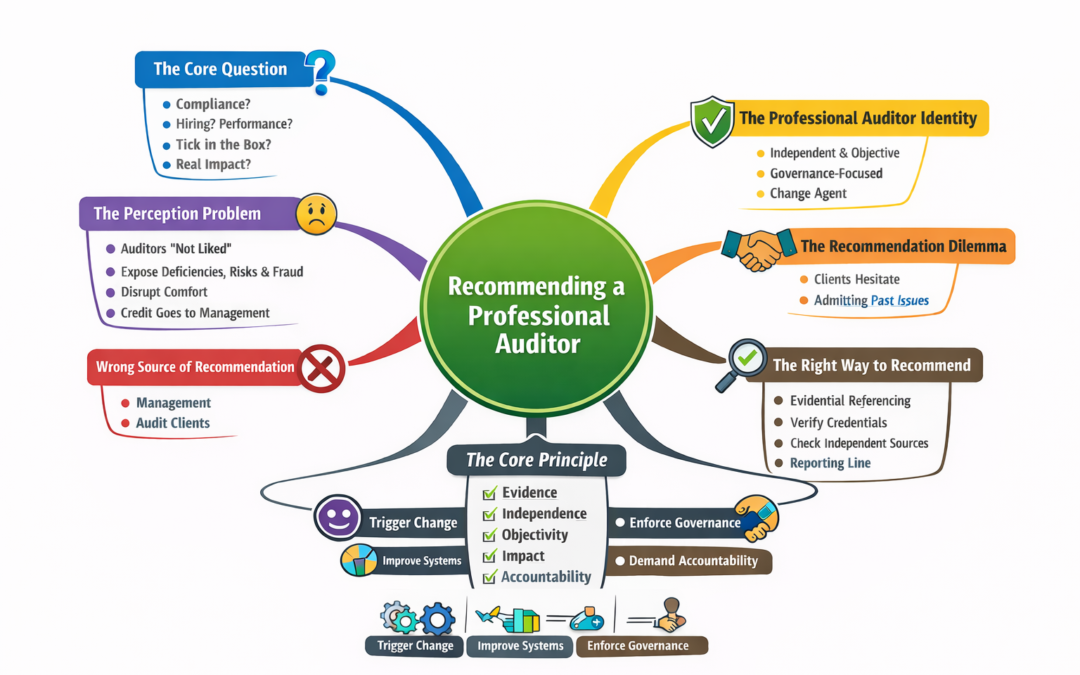
So, how do we recommend an auditor? But recommending for what exactly? For services? For hiring? To do what exactly? For a tick in the box, because you needed one to comply with the entity’s structural requirements? Or for getting the job done and objectives fulfilled?
Or you simply won’t recommend an auditor? After all, an auditor isn’t exactly the best of acquaintances to have! Not even a good one. And to recommend one you might need to experience them firsthand. And when there’s such an experience, it’s usually not a good one.
Hardly anyone I know ever had a fond memory of a professional auditor based on firsthand experience. Even those who tried to be in bed with us because they thought they could benefit from such a relationship later, had to regret it eventually, unless of course……. they were fellow auditors!
The key here is ‘professional auditor’. A career oriented one. Someone for whom the audit identity matters the most. And it only matters the most when the auditor lives up to the internal audit definition in requirements for objectivity and independence. Fiercely independent in conduct and wholly objective in approach!
So, when someone is fiercely independent in conduct and wholly objective in approach, how could they earn a good recommendation? Especially when those seeking recommendations and those giving them out are all audit clients!
Yes, that’s right, not all audit clients are problematic. But not all the client activities are free from problems either! And as professional auditors we ought to identify these to correct these and improve the activities, processes and systems. That’s also something specific to professional auditors, we’re not after problems but after factors that could limit the ability to evolve and improve.
So how do the clients go about these? When it’s such a conundrum to be in. A prospective client needs to know how good an auditor is from an existing client, and the existing client has no good words to say about the experience with the auditor.
Because when it comes to the experience with the auditor, clients eagerly forget how they changed for better, because triggers especially internal audit interventions don’t matter then. But what matters is how the auditors always had nefarious designs up their sleeves identifying client’s incompetence, non-compliances, violations and deficiencies.
How the auditors made the life of the client miserable by wanting them to identify risks, to rethink their approach, to redesign control, to have their conduct governed, promoted accountability, made things formal, systematic and disciplined.
And if the auditors were able to identify fraud and called out cheats the way they should be called, the auditors are known to disrupt peace and culture or more appropriately the calm and slack everyone was fond of and make the people subservient to governance and controls instilling fear of responsibility and accountability.
Mind you, it’s only professional auditors who can pull off such a show. Those usually filling up our ranks calling themselves auditors but are neither able to exhibit professional competence, nor demonstrate independence are not a cause of concern. Their recommendations come easy since they’re hand in glove with the managements.
For a professional auditor this is not a good thing. To be known as a trigger, an agent for change to improve and evolve is certainly not a comfortable identification, especially when it’s time for the auditor to seek recommendations.
Because when it’s all done, clients celebrate how it was them who achieved these feats and led the entity to new highs. No one remembers or likes to remember how and what made them get there. And when it’s the auditors behind, acknowledging them is like agreeing to some sort of deficiencies that were unearthed and resolved.
So how would you recommend the auditors? Because recommending is customary. Somehow, the work and accomplishments and their substantive ascertainment isn’t enough and so the good old recommendations are still needed.
And if it has to be so, let’s break down how this could be accomplished differently in case of professional internal auditors:
- Assessing career history to gauge the seriousness towards internal auditing.
- Assessing the career trajectory to evaluate the elevation to senior positions and enhancement in roles and responsibilities.
- Reviewing the credentials history to ascertain focus on professional development and specializations.
- Analyzing the milestones and accomplishments claimed on the profile and inquiring evidential support to back these up.
- Checking for former co workers to ascertain past acquaintances who could refer / recommend the candidate.
- Checking for publicly available recommendations of the work and the profile from people who were either fully independent or were not in a direct working reporting line to the candidate when they made the recommendations.
- Seeking examples of past deliverables from the candidate and the impact these caused.
- Review the initiatives taken and led by the candidate and their implementation.
- Obtaining a clear plan of action by the candidate for the new role if it is eventually offered.
- Obtaining references from the Board only if that is the reporting line.
Recommendations for auditors should never be sought from managements (audit clients). It just doesn’t make sense. Because as against any regular business-client service, auditors do not provide services to these clients, per se. They provide their services to the entity in furtherance of its objectives, by remaining independent of their managements.
So, when seeking recommendations for a professional internal auditor, let’s do it the way auditors do.
Deploy evidential referencing. And if it seems harder to obtain, ask the auditor to do it for you!
And dear executives, not all auditors are your typical average auditors.
Some like to keep a low profile but know full well how to perfect their exit plans. Don’t be fooled into believing we don’t know how to ensure a 5-star rating even after we’ve left!
We’ve something on everyone. We always do! Killing is how I’m known to make my living!