A bizarre question indeed. In a world full of disruptions that come uninvited, that’s the quirkiest query one could make or think of! And even more pertinent for the risk averse than the risk takers. Since there are always people who turn threats into opportunities (at least that’s what we’re told by management theorists), there might be people who would fancy disruptions?
And why not? If risks are the effect of uncertainty on objectives and this uncertainty could manifest in the form of a positive effect on the fulfillment of objectives, threats become opportunities. Similarly, management of disruptions could also take on a course that might become promising for any entity’s business, something that wasn’t expected.
For instance, the revelation of a new strategic direction, or the discovery of a previously unknown market, or the diversification in a new kind of product or service, or a significant opportunity of reducing costs, or a potential for process optimization that wasn’t possible before! All because of the disruption!
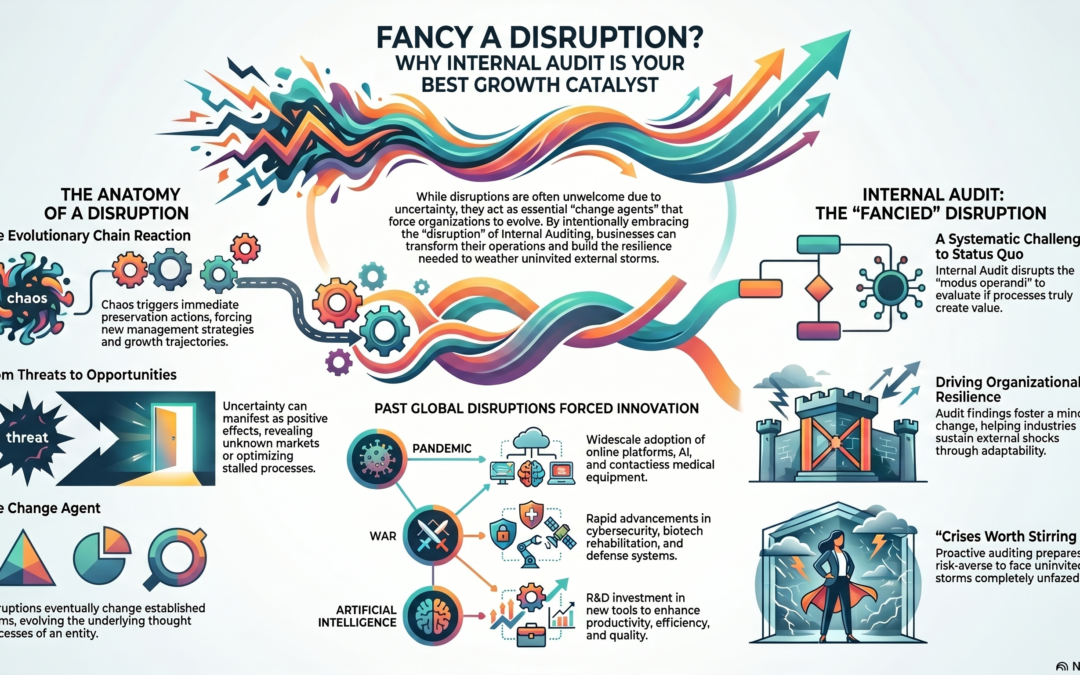
Or more appropriately because the disruption led to a chain reaction; caused chaos, activated immediate actions for preservation and restoration, triggered a thought process, forced a change of tact, led to a new management strategy and voila, the disruption had been maimed or even transformed into something better than before, or a new growth trajectory!
The key is the reaction towards disruption. Either it is despised or it is calmly approached and reviewed. And even if it is despised, it still has to be dealt with. Thus, approaching and reviewing it and then deciding the best course of action is ultimately, the only management approach.
Let’s look at how a number of disruptions from the not so different past and even in the present panned out:
|
Disruptions |
What did they lead to? |
|
Disruptions from Pandemic |
Investment in new technologies enabling widescale adoption of online meetings and conferences, e-commerce platforms, contactless, AI and sensors-based equipment in medical and official settings, etc. |
|
Disruptions from Natural Disasters |
Investment in early warning technologies, weather influencing studies, sustainable infrastructural development, use of renewable resources, improved food and medical preservation techniques for aiding people, improved and quicker shelter for those displaced, etc. |
|
Disruptions from Supply Chain Volatility |
Investment in R&D for alternate raw materials to be used in making required finished goods instead of sourcing, establishing manufacturing to make in-house rather than import from overseas, etc. |
|
Disruptions from War |
All negative impacts, but still economically significant for some like the manufacturing industry specializing in advanced surveillance, defense and offense systems. Additionally, conflict has driven investments in cybersecurity and finally in biotech to rehabilitate the victims. It’s so significant that now the so-called developed world’ has War Ministers! |
|
Disruption from AI |
Investment in R&D for new tools enhancing productivity, efficiency and quality, Investment in learning and adoption of new skills |
See? Disruptions, no matter how bad they seemed to be and how unaware and unprepared they caught us, eventually changed almost every established norm that was in place. Be it a change in the operating model, or a business model, or a new strategy, disruptions are the change agents. They are the triggers that lead to a change in the typical thought process.
And that’s the root of it all; the evolved thought process! The way we are used to go about anything and everything. Simply because in the normal course, events do not become disruptive but instead tend to act like hiccups, minor disturbances managed as a matter of routine.
Still, however, disruptions are unwelcome. Because they produce uncertainty that effects a predictable smooth sail and businesses like predictability to plan, to strategize, to grow and ultimately to profit. And hence the wisdom behind risk management.
But risk takers understand that some risks are to be exploited, not managed. And that’s exactly why not all disruptions come uninvited. Some are called for! Some are even invested into! And some are fancied! And once into a disruption, there’s one common management behavior; they are required to be dealt with!
And the biggest most significant disruption any business can fancy is Internal Auditing. Yes, it’s a disruption because it disrupts the modus operandi of an activity, a process, a system, an operating model, a business model, a sector, an industry and an economy. And yes, it’s for the greater good.
- It’s a disruption when it evaluates and determines that an activity is not helping a process and recommends its revision or cessation.
- It’s a disruption when it evaluates and determines that a process is not contributing to the system or that it isn’t fully optimized and recommends its revamp, replacement or suspension.
- It’s a disruption when it evaluates and determines that a system is not accomplishing the required objectives or that it can improve its accomplishment of objectives and recommends its transformation, dormancy or discontinuation.
- It’s a disruption when it evaluates and forces managements to change the ways they are used to operate and manage the operations, to make these resilient, evolved and improved.
- It’s a disruption when it evaluates and determines that a business model is flawed as it is unable create value and recommend a rethink of strategies.
Through its absolute dominion over the independent technical prowess that evaluates and improves the efficacy of governance, risk management and controls, and its systematic and disciplined approach, internal auditing consistently pushes (disrupts!) business into evolution and improvement.
And by virtue of the businesses, internal auditing helps an industry and economy sustain those other disruptions, through mindset change (from dealing with audit findings), maturity (from evolutions of the systems), manipulation (from education and experiences), leverage (from strengths and buffers), adaptability (from environmental alignment) and resilience (from organized fall back strategies).
For the antagonists and the risk averse therefore, internal auditing is a multitude of crises worth stirring up so that you could take on those other uninvited ones unfazed about the outcomes since you’ve what it takes to weather a storm; you’ve internal audit onboard.
Governance, Risk Management and Controls are not infallible but courtesy the internal auditing disruptions, their efficacy exudes assurance.
And Internal Auditing is a disruption in itself. The standards we’re required to adhere to cause us to adopt a formal, disciplined and business risk universe-aligned approach while conducting audit procedures.
They do not cap the imagination and creativity behind planning and conducting those procedures. So, we’re in a habit of evolving and improving everything within and around.
And we’re disruptive and hate the status quo!
Just like improvements are disruptive and a challenge to the status quo!