
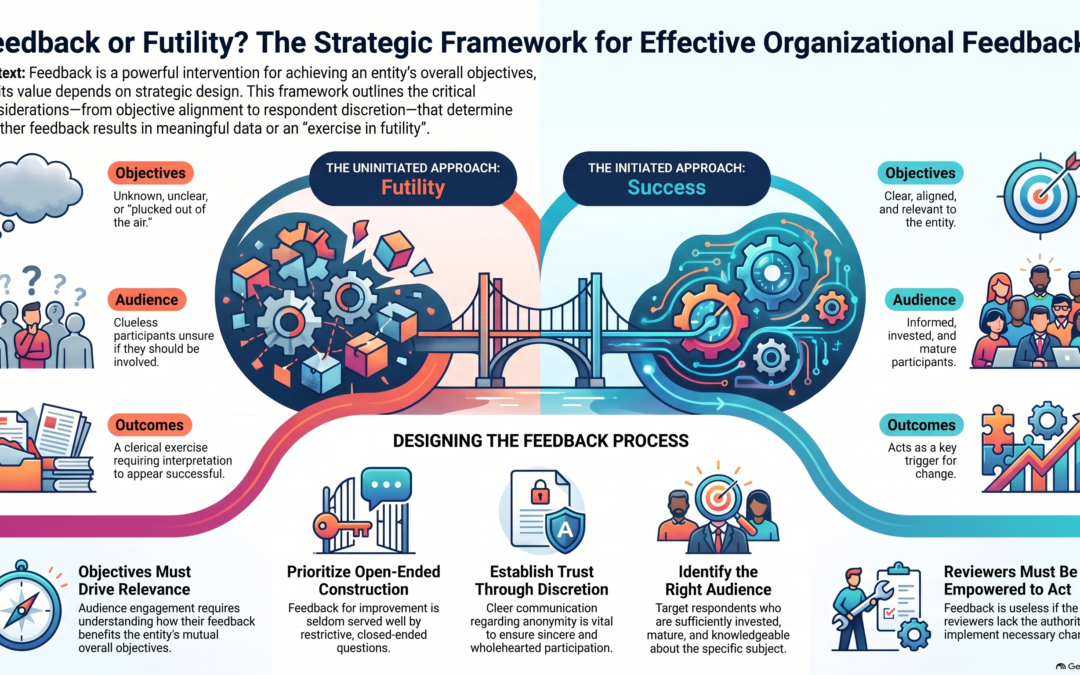
Feedback is important. Even for us the internal auditors. Getting our performance appraised and rewarded (or not!) accordingly is one part. Margin for improvement is always in place. And if based on constructive feedback from the stakeholders, it surely matters a lot!
Feedback aimed at accomplishing the greater good is always good, the greater good being the mutual overall objectives for which we all strive. It matters not if the feedback is focused on a singular, smaller domain, or purpose, as long as it remains aligned with the overall purpose.
And that’s exactly where feedback can be thought of being useful for an entity. Done sincerely and again, with the entity’s objectives in mind, feedback could yield benefits for the entity’s overall objectives in a manner that few other interventions may possibly match. And when it comes to doing it through surveys, the volume, and the time in which such feedback could be collected, feedback could be considered a key trigger for change!
With that said, it’s a simple task to record views as feedback on a certain object. A task that hardly takes any time and can be done conveniently while accomplishing other tasks. And why not if it could be done right, especially when it could become a trigger for change?
Well, from the objectives behind to its construction and medium of transmission, from the target audience to the ultimate reviewers, from the lifecycle state the entity is in to the future state it aims to be in, from the submissions being voluntary to these being solicited, from the process being discreet to it being traceable, and from the way it is collated and compiled to the way it is interpreted, using feedback for decision making requires a keen understanding of the objectives and the process involved and undertaken.
So, let’s take these on and do a bit of explaining!
|
Considerations |
How to be considered! |
|
Objectives behind |
Has the target audience been given a clear idea of why feedback is being requested? Do they understand the objectives behind being relevant to the entity and thus to be beneficial to them eventually? Are the objectives for the feedback actually relevant to the entity? If not, the objectives behind would never be understood as desired. |
|
Construction and medium of transmission |
How is the feedback being asked? Is it through open-ended questions requiring thoughtful expressions and opinions or closed questions requiring specific answers? Feedback for improvement is seldom served well with closed questions! Does the medium of transmission specifically precludes certain target audience from being able to participate or encourages responses from certain group(s) over others? The construction and medium of transmission need to be fully aligned with the objectives and their understanding. |
|
Target audience |
Is the target audience really the one that matters with the objectives of the feedback? Has the target audience acquired enough knowledge about the objectives of the feedback? Has the target audience gained enough knowledge about the entity / subject for which feedback is being requested? Are they invested in the entity / subject? Is the target audience mature enough to understand how feedback works and how beneficial their responses could be? |
|
Ultimate reviewers |
Are the reviewers of the feedback the ones who will be authorized and able to act on the feedback once it is there? What has been the conduct of the reviewers towards past feedback exercises? Do reviewers understand the objectives behind the feedback? Have the reviewers evaluated the feedback construction, its process and approved it? What is the audience’s perception of the reviewers? |
|
Entity’s lifecycle state |
Is the feedback timeline relevant (and beneficial) to the state the entity is presently in? Is the feedback content relevant to the state the entity is presently in? |
|
Entity’s desired future state |
Are the objectives decided for the feedback aligned with the future state the entity desires to be in? Is the feedback content relevant to the future desired state for the entity? |
|
Voluntary submissions |
Are the submissions to the feedback encouraged? Is the construction and transmission of feedback aligned to the encouraged format? |
|
Solicited submissions |
Are the submissions to the feedback solicited? Such that everyone has to provide input. Is the construction and transmission of feedback aligned to the solicited format? |
|
Responses discreet |
Are the responses going to be discreet and this has been communicated clearly? Does the audience agree with the sincerity of such communication? Have responses obtained on previous feedback (also communicated to be discreet) been kept discreet as well, with no repercussions? Does the construction of the contract align with the confidentiality premise? |
|
Responses traceable |
Are the responses going to be traceable and a clear communication to this effect given out? Is the audience agreed to the idea of traceable responses? Has the entity’s culture matured enough to not invite discrimination for individuals participating wholeheartedly when traceability is communicated? |
|
Collation & Compilation |
Who’s entrusted with the responsibility to collate and compile the feedback submissions? Is there a formal, traceable process in place to complete collation and compilation of the feedback responses? |
|
Interpretation |
Will the feedback responses be presented in the actual data terms or through an interpretation? |
How good the feedback exercise is going to be is dependent on how well these considerations that should go into the feedback process have been taken into account. In other words, the right answers to these considerations will give the right (intended) feedback answers and not the best answers!
Any ambiguity over these or not considering these would make any feedback exercise a clerical exercise (an exercise in futility!) that’s just required to be done! And it will be treated accordingly.
An inability to understand and consider these means the entity, the reviewers and the audience are yet uninitiated! It means the objectives for both the entity and the feedback are not known, the audience doesn’t know if they should be the audience, the reviewers are clueless as to what is it, they’re looking for in it, concept construction is plucked out of the air, future state is unclear and thus current state can’t be assessed, so collation and compilation aside, interpretations will be needed, simply to make the exercise a success!
It’s like saying maybe the outcome will provide the answer to the conceptual design at inception!
And targeting certain specific objectives and not the overall objectives means the feedback process is already selective. Since it aims to secure certain answers and not all answers!
When we’re asked to provide feedback, we do it certainly, but the exercise itself can’t be outside the magnanimity of our scope!
We’re part and parcel of the team, as long as the objectives of the team adhere to those of the entity we serve. Our paths might not cross when we determine the objectives do not align! As we’re always after those ‘other’ objectives that define the entity’s purpose!