Not just sad, but upsetting. That there was to come a time when Ethics would be in Demand. And not in Supply. That ethics would have regressed enough to be celebrated as a week, or a day, or emphasized through a conference or a seminar or talked about in a networking evening of ‘professionals’ over a cup of tea!
What is wrong with that, one may ask? Ethics is getting traction after all. It is being discussed, it is getting a mention. It means it’s considered worth discussing and what’s worth discussing is considered important. There’s really nothing wrong with that. Well, except everything!
Let’s come back to that everything later. First, let’s try to identify exactly how this downward stride to ‘demanding’ for ethical behavior started. But can we really identify that beginning? Maybe in terms of its demand amongst professionals can be identified but the demand in general, I guess is impossible to tell!
A simple prompting to AI (ironically where ethics is most abused at the moment!) suggests that the temptation to prioritize self-interest (something that has also been ingrained in human behavior and interactions) is the most probable factor amongst changing societal norms triggering shifts in understanding of ethics.
Undecidedly, that could be true. As true as the demand for law for establishing what’s acceptable and what’s not in a society. Self-interest and shifting understanding of ethics do in fact appear to be the root cause of why demand for ethics came to be or more precisely why Greeks thought of ethos!
However, to me that might not be the origin. My thought process, which might sound radical, comes to a different conclusion about the possible origins of ethics. To me the differentiation between what is believed to be good and bad at a personal level, and a societal level might be the origin of the demand for ethics.
The inexplicable divide between morality and ethics is the manifestation of such differentiation. This unfathomable ‘understanding´ that morality is personal, while ethics is not and so both are mutually exclusive. And thus, morality is a subject of personal belief, while ethics is what needs to be seen and shown to the world and so it cannot be personal. A person therefore could be different morally and ethically!
That to me is a tell all, not just origins but the problems with such an understanding as well. However, this blogpost is not meant for doling out moral advice and I am not one for it, either. This blogpost is about how and why the demand for ethical considerations and compliances is a disservice rather than a service!
Let us break it down through a review of the range of so-called ‘solutions’ for ethical compliances.
|
The Range |
The Nonsense! |
|
Code of Ethics / Code of Conduct |
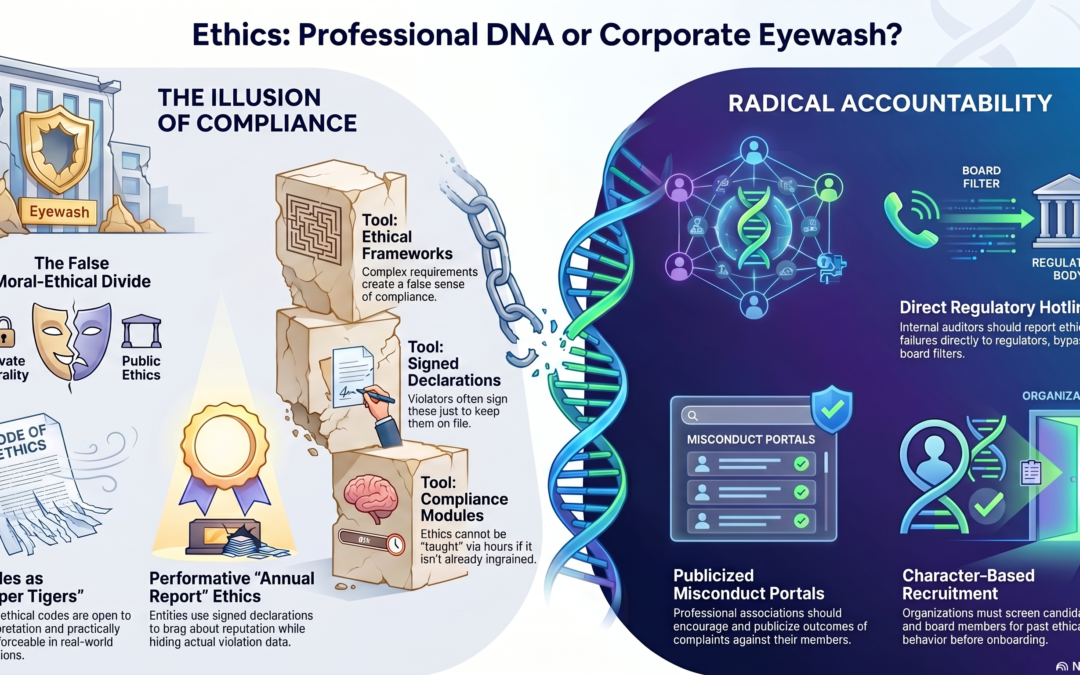
Organizations, Professional Bodies now have codes that mandate compliances from their employees and members. In many cases, these organizations and bodies are required to have these codes as a requirement of the statute / regulation. The codes advise on what is acceptable and what is not acceptable when dealing with fellow employees, customers, suppliers, fellow members, etc.
The applicability of the advice given on any particular situation is open to interpretation and the ‘mandatory’ compliance is unenforceable! While the codes are made part of annual reports touting their glorification and boasting about the organization’s reputation on paper, there is no reporting of incidents reported for ethical violations, how anonymous reporting was encouraged, how it was dealt with, actions taken and lessons learnt! |
|
Ethical Standards |
Many professional bodies have these. The idea is to allow the best practice examples to be adhered to.
Just as many work standards allow departure from compliance in the interest of fulfillment of objectives, recording explanations of the departure, there is no bar in making departures from ethical requirements presented as standards in any ‘situation.’ |
|
Ethical Framework |
Codifying what is essentially required to be ingrained, entities put in place ethical frameworks requiring conformance to these.
Instructions, Guidelines, Policies cannot ensure conformance. Instead, frameworks make requirements around ethical conduct complex giving a false sense of compliance. |
|
Declarations / Statements / Returns |
Many Organizations and Professional Bodies ask for signed declarations, statements on ethical conformances and allegiances to their codes. Entities are even at times required by virtue of statute or regulation to file returns evidencing their conformance.
Certainly, signoffs from those responsible for ethical violations are always in file! |
To sum it all up, codifying ethics in any of these forms ensures that the entities have something to brag about in their annual reports, on their websites, as part of their submissions to the regulators, etc. Thereby ensuring that they can show, for the record, that they ‘acted’ ethically!
And now that we are having a renewed push for ethical considerations with every advancement, it begs the question, are we actually advancing or regressing?
The professional associations require ethics modules and ethics hours for completing qualifications and continuing professional development requirements. They do not just think that ethics are important for professionals, but that professionals needed to be equipped with ethics now and not before! And that this is most surely the way to go!
Standard setters have also gotten onboard the ethics bandwagon. We now have sustainability standards requiring ethical approach towards an entity’s impact on its operating environment. The upcoming version (2026) of ISO 9001, the gold standard for management systems, is also making ethical considerations a requirement.
And the latest to this “demand for action” is AI. With its prolific criminal prowess, AI tools use cases as deepfakes, frauds, privacy invasions, lack of originality and massive use of resources, it is no wonder that the world is again demanding ethical considerations and human in the loop around AI use.
Now, want some real questions?
- What about ethical violations at the board level? Is there a screening process for Board members looking at their past ethical conduct?
- Ethical Considerations at recruitment? How many organizations and professional associations screen candidates and potential members for their past ethical behavior?
- Do regular ethical declarations serve any purpose?
- Could there be a professional who isn’t ethical?
- Can a person be different in professional and in personal life?
Well, at present, there are not any answers to these questions but there are certain proposals I would like to put forth to ensure ethical considerations in business (aka work ethics) are not an eyewash:
- Complaints against professionals be encouraged. The professional associations should encourage and in fact publicize portals for receiving misconduct complaints against their members serving the industry and businesses, especially accountants and auditors. The outcome of proceedings on such complaints should be shared with the complainants.
- Ethical evaluations of employees and members undertaken by managements of organizations and associations must be reviewed by their Boards.
- Regulators hotline with auditors. The auditors report to the Board. However, the regulators need to have a dedicated and direct line with the auditors, especially the internal auditors (since external auditors’ scope is limited and they are a function of the statute in many jurisdictions) of all entities working in regulated industries, listed on stock exchanges and in the public domain. This will ensure reporting of all ethical violations and governance failures of the Board to the regulators.
To demand ethical behavior and allegiances to an ethical code from professionals means these can be two different things when in fact they cannot be. A professional cannot be a cheat!
The demand for ethics is in fact nothing but a demand for professionalism. If businesses and associations have to seek out ethical behavior from their employees and members, they have not hired and on-boarded professionals!
Ethics could never be in vogue because it could never be outmoded. Ethics cannot be enforced if it is not instilled. It cannot be implemented if it is not ingrained!
Ethics define professionalism, just as morals define us. They are not distinct. Codes or no codes, ethics is in there unless it is not.
However, if you insist on having a code of ethics, we, the auditors, are always looking forward to invoke it! After all, we’re just providing assurance on compliance!