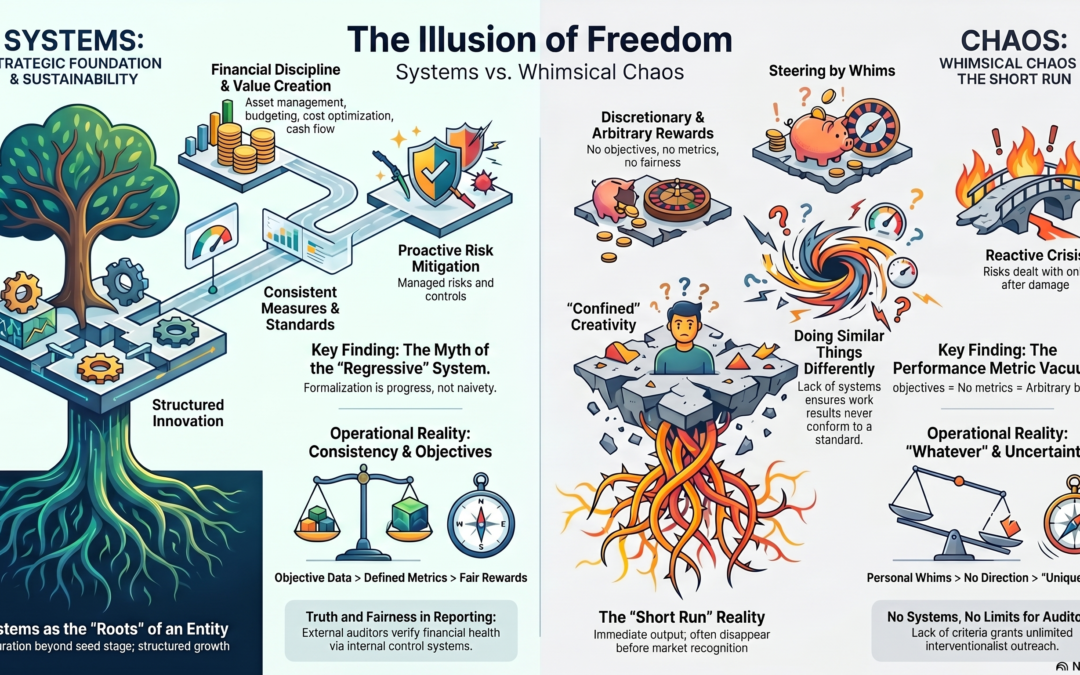
Exactly to this day and age! There are people who prefer their persona and approach over systems, processes, policies and procedures. People who believe being organized and formalized is being regressive because they believe systems don’t evolve. Or people who believe the systems limit their imagination and creativity, because systems confine them to a certain kind of approach, so having no formal approach is a better approach!
Well, I can tell from my personal experience, naivety also has no limits when there aren’t any systems. So, whatever the reason be, if you’re starting an entirely new entity and helping it grow shoots before it grows roots, or you’re confident of the subpar skillset you’ve hired such that you believe they cannot fulfill any requirements and thus objectives of a system, it’s better not to think of developing a system!
After all, being unsystematic allows entities on seed funding to not consume time, effort and resources in organizing and developing itself but to spend all its energies in contributing to the overall industry value chain. Its own organization and development can wait.
Likewise, not thinking about being systematic allows the entities’ employees freedom to think beyond the ‘confines’ of a system and yield outputs that are not ‘chained’ or ‘accustomed’ to the objectives of establishing an organized entity. An organization is not meant to be organized right?
I mean what good are the policies and procedures that govern and guide the processes that make up systems anyways? Apart from being regressive or a thing of the past? Aren’t these things that hold us back forcing us to follow a certain approach and working to a consistent measure and a comparable standard? Who wants that right?
And so, when there are no systems, we can do away with controls as a means to mitigate risks to accomplish objectives. And we can do away with thinking about risks as we would be certain that we would deal with them as and then they materialize. And we can do away with objectives because we can’t limit ourselves to certain objectives!
Similarly, we’ll then be able to do away with thinking about risk management and control processes. The entity will flourish without these processes. But wait, what about governance? If the organization doesn’t need to be organized, what is there that will need to be governed?
Nothing! Entity will be governed whimsically. Whims will steer the entity towards success. And because remaining unsystematic has been decided systematically, there will be no systems to measure and evaluate success. Because mind you, performance metrics are derived from objectives that the entity has decided not to have.
The performance against those objectives are evaluated against a criteria and the entity decided against having a system of evaluation so there’s no criteria. And well if there’s no criteria, let’s have discretionary bonuses or ex gratia payments. Isn’t it satisfying that no one has to do anything in accordance with something?
Instead, what they can do and what they do is whatever! Exactly! Since there’s no system to abide by, everyone will do similar things differently, achieve different results that won’t conform to any standard because there’s no standard to be committed to and no result could be measured or evaluated.
Indeed, that’s the idea of a unique entity. An entity so unique that it has no idea where its headed and if its headed somewhere. The people leading it, driving it, the ones who champion the cause of being unsystematic will be there to enjoy the ride while it lasts.
Maybe the architects of such entities believe that it’s good to be different. That having systems and committing to them is so dated! That while all other entities have systems, they decide to have no systems at all. And they believe that this novel approach gives them the first mover advantage in the market it serves.
Doesn’t matter if and when the market starts recognizing the entity, it’s already long gone! Even though it is so short a run to be meaningful, a run it is nonetheless! A run that does not even secure a place as a case study of how not to operate!
After all, it’s not systems that run the organizations. It’s not systems that run the fortune 500 companies. It’s not systems that run the capitalist business and economies. It’s not systems that run the governments and the countries. Nothing can be attributed to the systems, at least not their success, resilience and growth!
It’s not systems that are responsible for work consistency, quality and standardization. Systems aren’t responsible for reliability, dependability and durability of operations. Systems don’t ensure transparency and accountability. Systems don’t control, contain or mitigate risks. It’s not systems that are put in place for managing operations. And it’s not systems that are automated.
I don’t really understand when people say business value is created by systems and processes and that governance systems ensure sustainability. I don’t understand how systems are responsible for sustainability and longevity. And the belief that its systems that help an entity grow is baffling. And when it is said that shareholder wealth is created by systems put in place by management to manage the affairs of the entity, it seems a bit of a stretch.
Because,
- Systems aren’t responsible for streamlining operations and workflows.
- Systems aren’t responsible for asset management.
- Systems aren’t responsible for budgeting and forecasting.
- Systems aren’t responsible for revenues.
- Systems aren’t responsible for cashflows management.
- Systems aren’t responsible for financial discipline translating into costs optimization and profitability.
- Systems aren’t responsible for keeping the entity afloat.
- Systems aren’t responsible for stakeholder value creation.
Instead, it’s the whims of those managing the affairs that are responsible for all these non-objectives!
Even the external auditors ‘do not’ rely on the internal control systems in the form of accounting and other systems put in place by the management to give an opinion on the truthfulness and fairness of financial information produced by the entity as a reflection of its affairs.
Governance, Risk Management and Controls are also systems. And they aren’t needed because sustainability and growth aren’t the objectives. And so, what is in there for internal audit?
Well, there’s nothing to stop us internal auditors then!
If you think you can avoid our interventions now that you don’t have any systems and by virtue of that, the audit criteria, you’re grossly mistaken.
Those systems, had you invested in them, might have put limits to our assurance based queries.
Now that there’s no such thing, there are no limits on our technical prowess, disruptive power and improvement oriented interventionalist outreach!
Enjoy!
P.S. The blogpost was meant to be a piece of satire, if it wasn’t obvious!
And there are countries that don’t rely on systems. Instead, they rely on blackholes which countries having systems finance through donations or loans!