Because for most managements, I’ve experienced it’s hard to grasp. Not just the independence concept but the reason why it matters or should matter. They are at a loss to understand, why would someone think or act independently and not get along with the management’s “vision”. And thus, for such managements that or those someone acting independently have a ‘vision’ of their own, which they believe is at odds with theirs!
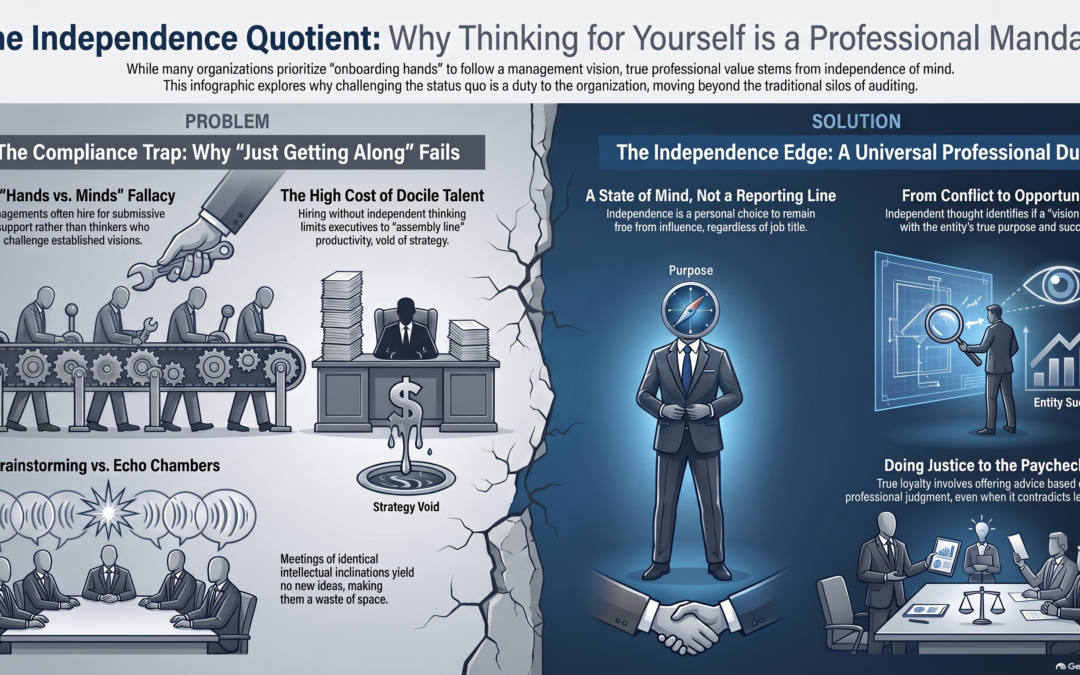
Seems like professionals having a mind of their own is bad. Likewise, independent thinking, aka thinking differently is not something considered good or worthwhile. After all, when hiring talent / people, managements are thinking about onboarding greater number of hands, and that’s what’s meant by teams!
It’s not that they are on the lookout for thinkers, strategists, innovators, challengers, change agents, etc. Skills, experiences, exposures matter certainly, but only in the context of being a support to the established vision. Not the ones that seek to challenge that established vision.
Meaning thereby, a head on shoulders is fine, unless it also thinks and challenges. A head that thinks or challenges might hinder the realization of the management’s vision. Because the management’s vision is the mainstay in ensuring the entity’s success and even a thought that serves to deviate / challenge this vision needs to be tamed and brought in line.
But hey, how could this be true? Hiring like this, inclined towards finding talent that’s submissive and docile, might be suited for assembly line positions, i.e., unskilled or semi-skilled labor! How could talent sourced for executive positions be void of the basic mental faculties of thinking, planning and strategizing?
One might think that having thinking heads doesn’t necessarily mean that such people would behave independently or differently. But then what would be the use of having a thinking head is my question! A mind that is unable to think independently is even able to do anything?
A mind that’s got nothing of its own, has got no ideas to offer, no inputs to make, no advice on how to go about a task, no opinion for how to tackle an issue, no planning to accomplish objectives, no strategy for growth actually brings nothing to the table! Is such a mind anything more than waste of space?
More? Why have meetings to discuss issues when everyone has to offer the same? What does it mean to have brainstorming sessions for all like-minded individuals or more appropriately individuals having identical intellectual inclinations? Why seek advice or feedback from everyone, when everyone thinks alike and have nothing different to offer?
Agreeing on an issue to be resolved, a problem to be tackled, an objective to be accomplished, a vision to be achieved is one part that people could agree on. How then they go about in getting there couldn’t just be different, but in fact needs to be different. That’s especially true for hiring at the executive level. At that level thinking independently is so much more important that it could make all the difference.
- Independent thinking at the executive level would be able to analyze if an issue is significant enough to warrant resolution or if it’s better to have it in terms of cost of the resolution.
- Independent thinking at the executive level would be able to see the problem differently and identify its potential to become an opportunity.
- Independent thinking at the executive level would be able to ascertain that an objective being focused upon is in fact not directly aligned with the purpose and thus a different objective is more relevant.
- Independent thinking at the executive level allows a rethink of the entity’s vision.
That’s what independent thinking has to offer. Not just identifying the various means to get there, but also if getting there is the right call to make! Independent thinking is rational thinking. Independent thinking is difference of opinion that ensures a number of options are available to choose from. Independent thinking is the diversity every business entity needs to embrace. Independent thinking is what moves the business.
Now let’s get to the features of independent thinking:
- Independent thinking is free.
- Independent thinking is non-conforming.
- Independent thinking is unguided / out of the box.
- Independent thinking doesn’t subscribe to any doctrine.
The most significant amongst these features is freedom from any and all kinds of influence.
And when it comes to be free from influence, the most important stakeholders any entity can think of are the auditors. The standards, the codes, the statutes require us to be functionally independent. It requires our reporting to be independent of the executive / management.
Because:
- They require us to be free from any influence when planning, strategizing, executing and reporting our audit engagements.
- We’re required to be independent in our audit approach.
- We’re required to steer clear of any potential conflicts of interest.
- We’re required to be objective not just in our work and approach but also seen to be independent.
And because we’re required to be able to think independently and exercise our best professional judgment, in our efforts to serve our clients. This is only possible when we are positioned independently.
But what about other professionals? Can’t they think independently? And if not, why not? Shouldn’t they think independently as well? And if not, why not? Auditors are positioned independently. But that doesn’t mean that our independent thought process is dependent on our organizational independence.
Case in point, why the standards and statutes needed to emphasize upon auditors’ independence? Because otherwise we could have been biased in our audit approach and reporting. Still however, what we do about our thought process is our own doing. The organization we serve might have positioned us by the book, yet we might not be able to have an independent thought process, if we for instance decide to side with the management and be hand in glove with them.
Similarly other professionals can and should be independent in their thought process and their actions. Being part of operations doesn’t mean one has to be void of independence. Independence is a state of mind. It’s not about the reporting lines!
And it’s actually pretty easy to be independent and to be able to exercise independence and become a truly independent professional. It only requires basing one’s thought process and actions on one single core. That one single core is the organization employing professionals.
Because when hiring a professional, the organization is only concerned with the skillset, talent, experience, exposure and competence the potential recruit will bring along. If that professional is not going to be independent in thoughts and actions, the recruitment drive failed to deliver!
And that’s a lesson for hiring managers. To look for examples in past experiences of professionals whereby independence of thoughts and actions manifested is an absolute necessity.
My bestie recently apprised me how being a CFO he exercised independent professional judgment and gave advice that was contrary to what the CEO’s viewpoint or more appropriately, his wish was. The advice was given to the Board, and it decided to side with the CEO.
But the CFO not just ended the day satisfied that he did right by the organization he serves, he also made it clear to the Board that he has the ability to think and act independently!
In time he will be known for this!
And that’s enough for us. He did justice to his paycheck!