Exactly! What good governance is if there aren’t any principles to care for? If we aren’t going to be responsible for our conduct? If we aren’t going to be accountable to anyone for our actions and inaction? If we aren’t going to be answerable for our decisions? And if we lack any moral code?
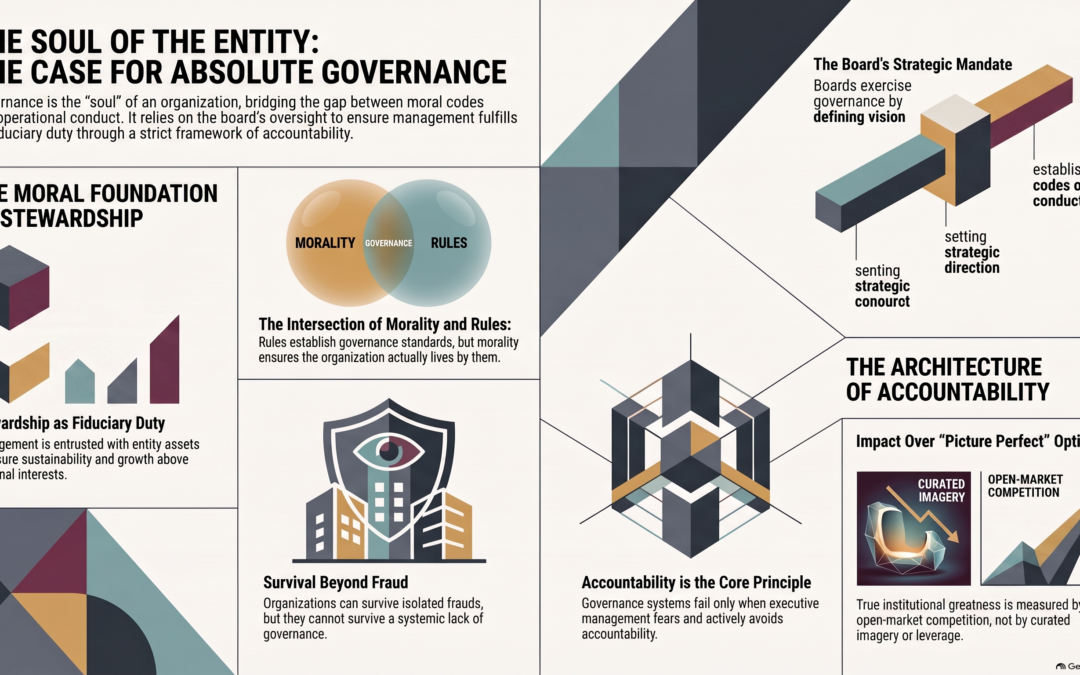
But wait, morality? What has it got to do with Governance? Everything is my unequivocal answer! Because rules and principles are common in both. Because governance ensures we comply with those rules and principles. Because morality ensures we live by those rules and principles.
In the context of corporate world, we’re in a contract with our employers. Under this contract, we’re responsible to be in compliance with certain terms and conditions. And there are obligations / objectives to fulfill. And if we don’t, we’re in breach of the contract. A breach that could very well become a material default!
We’re held accountable for the breach and the material default. The contract is then voided. Under the contract, we are compensated for the services we provide in support of the entity’s objectives. Not providing services to that end while the employer holds its end of the contract is moral turpitude and not holding us accountable for the quality and effectiveness of those services is a lack of governance.
Under the principles of corporate governance, the management is responsible to provide stewardship. The day-to-day operations and the responsible use of the entity’s assets are entrusted to the management’s care and that’s what stewardship represents.
It is the management’s fiduciary duty to ensure they act in the best interest of the entity they serve, i.e., their employer and put its interests above their own interests. They’re hired to make the entity sustain and grow and that’s how they are required to justify their paychecks.
Could this stewardship be effective in the fulfillment of the entity’s objectives and purpose under which the stewardship is awarded, in an environment where moral turpitude is ignored and lack of governance is celebrated?
Should the management be simply assumed to have fulfilled its fiduciary responsibilities without anyone checking up on them? What purpose do the regulators, watchdogs, auditors serve then? Why not take management’s word on their compliances and fulfillment of responsibilities? Why not rely on the financial information produced by management without the need for having it audited?
And why then have Boards? If management is self-sufficient in conducting itself, behaving rationally, thinking clearly in terms of the entity’s objectives, is committed and loyal to the entity it serves, is always free from bias and doesn’t let conflicts of interest get in their way, has an impeccable ethical record that it is sure to replicate always, why do we need Boards? For what?
Because Boards are the representatives of the owners! And they represent Governance!
The boards exercise governance by:
- Defining the purpose, vision and mission of the entity and ensuring their communication
- Setting the strategic direction of the entity and its objectives and ensuring their communication
- Identifying the operating environment and stakeholders and their influences
- Establishing the values system and codes of conduct and ensuring their communication
- Reviewing and Approving significant policies
- Providing oversight
- Reviewing the corporate performance / management stewardship
And Governance, as defined by The Institute of Internal Auditors, being the combination of processes and structures implemented by the board to inform, direct, manage, and monitor the activities of the organization toward the achievement of its objectives entails:
- Policies
- Rules
- Processes
- Codes of Conduct
The core principle through which governance works is accountability. And governance becomes a problem when executive managements are afraid of accountability. That’s when they try their utmost to ignore calls for establishing governance systems. Little then they realize that sustenance and growth are the end result of Governance!
If you are trying to build around yourself, you aren’t building an entity or an institution to outlast and outlive. You might be thinking of building your empire that would keep you there. But nothing will guarantee you a stay forever!
What guarantees your presence is the impact that outlasts you. The impact that becomes the soul of the entity. The soul is what guides us through and that’s the core. Governance System is that soul and thus the core!
An entity can survive frauds, but it cannot survive lack of governance. Because fraudulent practices are not just unearthed by governance, they’re resolved, acted upon, and prevented by governance.
Recently I came across some pictures touted as evidence of how great the people were in the picture because they believed they built a great entity. When it comes down to showing the pictures that no one asked for as evidence of something “great,” you’ve lost it already!
I looked it up instantly and found that the great entity does not make it to any top listings of the sector it operates in. Simply because it operates on a turf of its own. A turf away from governance, risk management, and controls systems. And like I said before, coffers or statute-based leverage can put you there but can’t make you compete in any open and fair market!
You can brag and boast all you want but may as well consider using that leverage for a place in the listings!!!
“Yes, we’ve been tasked with efficient use of public resources, not just in our operations but also through our services. But since governance is not something we’re known for, we’ll have this part of the entity’s purpose removed!
Thank God, there wasn’t any governance at play when this was included and there won’t be when it will be gone!
But trust us, for we build entities that are great even when they’re void of governance.
Entities with affairs elusive from the public eye financed by public resources!
We’ll do it again because we’re armed with these pictures we hold dear. We’re picture perfect! At least we believe we are!”